Scenes from Hong Kong


(Click on any image for a larger version.)

Just back from my first visit to Hong Kong—long in the anticipation. Some random observations:


This shopping-mall display brought to mind this old National Lampoon cover from 1972:

I won't really go into it, but in 1972 this was a timely and clever joke. The big panda warrior had hundreds of little minions:


This business was a mystery at first sight. I haven't taken the time to really decipher the Web page, but my best guess is they purport to assess the talents of individuals (especially children of achievement-obsessed parents) by analyzing fingerprints.


At first glance I thought this was Spanish moss hanging from the tree, but it turns out this is a Chinese banyan tree (several of which line Nathan Road in Kowloon). The dangling things are root-like structures which I guess are the tree's attempts to spread itself horizontally. But, surrounded by pavement, the poor tree is doomed to an existence of sexual frustration.


Best (and cheapest) thrill in Hong Kong (technically not Hong Kong but the Kowloon peninsula facing the island of Hong Kong): walking the waterfront promenade at the tip of Kowloon at twilight. By accident of topography, the Kowloon peninsula is surrounded and embraced by Hong Kong island as the map below shows, so the Hong Kong skyline presents a sweeping view. (Second-cheapest thrill: taking the Star Ferry from Kowloon to Hong Kong at twilight or night, which costs less than a dollar.)


Looking down on the Hong Kong skyline from the ridge of the island.


Since Hong Kong island was almost uninhabited until the British established a colony in 1841, there are no thousand-year-old temples to be found. There are some younger ones, such as the Man-Mo temple, built in 1847. 


The Man-Mo temple in context.


Entrance to Jumbo's floating restaurant in the Aberdeen district of Hong Kong. Actually, the restaurant exists as a large boat, with the kitchen on a separate boat alongside. You take a smaller boat to reach the restaurant. This has overall the most extravagantly exotic menu of any place I visited.


Note the expression "海天潜水" appears twice in this picture, with two different translations: "Scuba Diving" and "Ocean Sky Divers." Google Translate renders this phrase as "Sky Dive." (The individual characters mean "sea-heaven-submerge-water".) The dictionary didn't help to clear this up, but the image itself gives clues: PADI is a scuba-diving organization, and the red silhouette of a scuba diver, if you can make it out. Note also the use of bamboo for scaffolding.


These apartments we saw on the way to the airport were awe-inspiring (perhaps less so from the inside). I could only capture a small piece from the taxi window, but the block extends like a vast 300-foot wall.


Haunting advertisement which instills the irresistible urge to buy... well, I don't know what, exactly, but I've got my wallet and I'm headed to the store. 


And, finally, a subtle escalator-cultural-psychology observation. In the USA, a string of escalators is typically arranged head-to-tail, so that one travels upward in a zig-zag pattern. Up and down escalators are intertwined in a sort of flat double helix. People traveling on the up- and down-escalators would be facing the same direction. In Hong Kong, the up- and down-escalators are usually arranged in pairs so that people ascending are facing in the opposite direction from people descending. And then to reach the next escalator, one must walk around from the end of one to the start of the next. Frequently the next set of escalators is even in an entirely different location. 

The skyline picture above shows non-parallel escalators, but even there one had to walk to get from one escalator to the next.


Io Globe

Globe of Io, third-largest moon of Jupiter, in real life roughly the same size as our own moon. Globe purchased from the interesting collection at Android World. Customized with a wooden stand assembled from off-the-shelf parts: turned cabinet leg, drawer pull. threaded rod, wood finish, and some plumbing parts from hardware store. Clock plaque and felt from craft store.

Launching Mayan

Thanks to a confluence of factors:

1. The publication of Johnson's useful textbook on the subject;

2 My experience with using Anki flash-card software in the past few years. Anki's ability to handle images is crucial for this project.

3. Accumulating insights into cognitive strategy;

--I recently took up the study of Mayan glyphs. This is something I have planned on doing for years. In the future I'll travel to Central America to check them out in the field.

I want to make a few remarks on my study system for Mayan. What I will not do in this post is to discourse on the Mayan glyphs themselves, beyond pointing out a few interesting points.

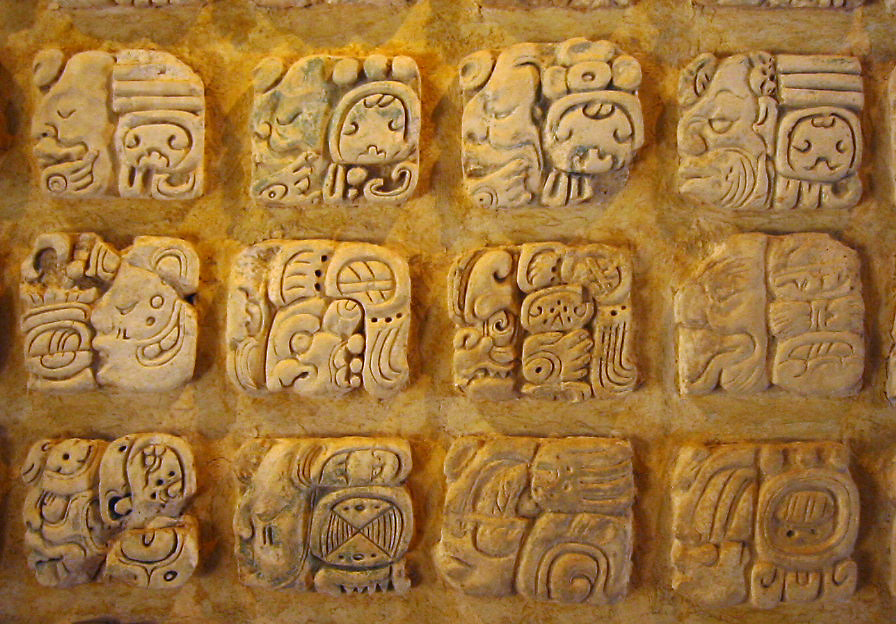
One such being that almost all of the world's scripts trace their origin to pictures (Korean script seems like at least one exception), but most have evolved to the point where it is difficult or impossible to recognize the original depiction. Mayan glyphs hew closely to their pictorial origins, as the sample above demonstrates.

Or look, for example, at a glyph for the syllable "A", taken from a picture of a turtle:


Compare, for example, to the Chinese ideogram for "turtle":


This is quite a bit more stylized, although still vaguely recognizable: legs on the left, carapace on the right, head at top, tail at bottom (and this is as pictorial as modern Chinese characters get).

And by the way, who draws a picture of a "turtle" and stops with the head? It goes to show how culture affects the way we see things in unexpected ways. The Mayans really seem to like pictures of heads; how many can you count in the sample above?

Although Mayan is not a dead language (plenty of folks speaking Mayan as you read this), the glyphs essentially qualify as a dead languagethe ability to read them having been lost and only recovered fairly recently by dint of enormous effort. I am therefore applying my "dead language" policy to this project, meaning that I am concerned essentially with reading, not at all with writing or listening, nor speaking, beyond the bare rudiments of pronunciation. It actually make sense to pay some attention to pronunciation with any language, dead or living, as every script I have come across so far relies at least somewhat on phonetic relationshipsand Mayan glyphs certainly do; a single word can be written in multiple ways, linked only by its pronunciation. Some of the speaking and listening activities I would normally rely on in language study are therefore irrelevant.

Anki software is quite adept at handling a variety of scripts, but I'm not sure whether fonts for Mayan glyphs exist (Unicode does not appear to include a relevant coding standard), but the very idea of a font is rather foreign to the script. Any given glyph appears in at least a a few variants, with great allowance given to the artistic inclinations of the individual scribe. I'm not sure whether any given glyph ever appears twice in exactly the same form.

I therefore rely on importing images into Anki. I can scan or clip source images (such as the turtle-head above) and paste these into Anki flashcards.

A feature of Anki is the ability to associate several cards with a single "fact", which is a set of associated data fields. In this case each "fact" consists of seven data fields:

(1) The image of the glyph.

(2) The pronunciation. Some glyphs may have more than one such, in which case I list them.

(3) The meaning. Some glyphs represent sounds only, in which case this field is void. Others may require a listing of several possible meanings.

(4) The object depicted. This is distinct from the "meaning", in that a glyph which does not mean anything as such may still be designed to resemble a real-world object  (this is the case of the turtle-head glyph above, which does not have an associated meaning but merely represents the 'a' sound).

(5) A mnemonic phrase. I found this extremely useful in learning the Thai alphabet, For example Mr. Turtle Head up there gets the somewhat arbitrary name "Angry Turtle." The "Angry" is to remind me that the sound is "a". Or, again, the glyph


which is pronounced "i" and depicts I-have-no-idea-what, gets the nickname "Icebox." The glyph


which is pronounced "ba", gets the nickname "BAgel". I don't necessarily plan on coming up with a mnemonic for every glyph, but certainly the purely phonetic ones.

So I could use the following cards for each Anki "fact":
1. Stimulus: picture of the glyph. Response: the glyph's reading, with the mnemonic provided as an after-the-fact hint.
2. Stimulus: picture of the glyph, and the reading. Response: the glyph's meaning.
3. Stimulus: picture of the glyph and the reading. Response: the glyph's mnemonic.
This is in line with the principle that the response for any card should be short and sweet as possible. If a card's response consists of two or more pieces of information, it's better to use multiple cards, with one piece of information each. Not every glyph gets every card. If the glyph has no inherent meaning, I skip Card 2. If I don't assign a mnemonic, I skip Card 3.

If previous experience (with, for example, Egyptian hieroglyphs) serves, the more pictorial the script, the more easily is sticks in the mind. In fact for the first 21 cards, Anki reports my success rate is 100% (whereas typical is more like 85%).

Turks and Caicos - March 2014

Click on any photo for a large version...


Hone Your Visual Sensuality and Eloquence with the Game of Kakiemon

Photo by Coolmitch

[This game takes its name from the 17th-century Japanese potter who,   inspired one evening by persimmons hanging from the tree and bathed in the glow of the setting sun, spent years obsessed with reproducing that exact shade of orange in porcelain. When he finally succeeded, he changed his name to Kakiemon (loosely translated as "Persimmon-guy").]

Assembling the game apparatus: At the hardware or paint store, pick up a collection of paint chips. How many and in what colors is up to you. The more shades you choose and the more subtle the distinctions between them, the more challenging the game. Get two identical copies of each.

Clip out the color part(s) of each chip. In particular, be sure to cut off and discard the name of each shade (although you may optionally make a note of it for later). To keep track of all these colored rectangles, you write codes on the back of each. Two copies of each shade: one copy gets an even code number on the back; the second copy gets a random unrelated odd code number. Each code number should be unique, so you can use them to identify the color. Make a list which shows the even code numbers in sequence and the corresponding odd code number for the same shade for each.

How to play:
You need three players. On each turn, one player is sender, one is receiver, and one is checker. Separate the cards into a pile with even code numbers and a pile with odd code numbers (thus each pile will have one copy of each color). The sender and receiver face opposite directions so they cannot see each other. The sender gets the pile with even code numbers, the receiver gets the pile with odd code numbers, and the checker gets the list of what matches with what.

Set a timer for a fixed interval, say 3 minutes. During this time, the sender draws cards at random from the even-numbered pile and shows it to the checker, who looks up the even code number on the list (and thus the corresponding odd number, but don't tell what it is). For each card, it is the sender's task to describe the color verbally so that the receiver can locate the same color. The sender can specify the color by name (if remembered, but there's no guarantee that the receiver will also remember), or use any kind of description (the color of persimmons in the glow of the setting sun; the watery green of a pane of glass seen edge-on, etc.). The receiver gets one guess as to which color is being described, but can ask for more information or even specific questions. The checker's only job is to verify using the code numbers whether the receiver has selected correctly. For each correct identification during the fixed time interval, both sender and receiver get one point.

At the end of the time interval, roles rotate: the sender becomes the receiver, the receiver becomes the checker, and the checker becomes the sender. After three turns, reverse the sender and receiver and continue by rotating for the next three turns. This way each sender gets to work with each receiver.

In other words if the first turn has Sender=A, Receiver=B, Checker=C:

Then the second turn has Sender=C, Receiver=A, Checker=B;

The third turn has Sender=B, Receiver=C, Checker=A;

The fourth turn has Sender=C, Receiver=B, Checker=A;

The fifth turn has Sender=A, Receiver=C, Checker=B;

The sixth turn has Sender=B, Receiver=A, Checker=C; This completes one round.


And then the seventh turn repeats with Sender=A, Receiver=B, Checker=C, etc.

Continue rounds until you can stand it no longer, and total up the points for each player.

So who will be good at this game? I expect that, like most things, skill will improve with practice. Some people just pay more attention to colors than others. The (Anglophone) world is divided into to groups: people who know what "taupe" is and people who don't. My hypothesis is that people in the worlds of fashion (or even those who work the cosmetics counter of a department store) would have an advantage at this game.

Difficulty can be adjusted easily. For very small children

This game is not unlike the face-matching game that I described earlier.