Do the Chinese Ever Have a Word for It...

My pastime of late is browsing through Herbert Giles' mammmoth 1892 dictionary of Chinese characters. (You can download it for free from Google books--search for "giles chinese dictionary".) The dictionary contains roughly 13,848 characters. It's hard to know exactly how many, as some characters are listed in more than one position (having more than one pronunciation). This is vastly more than practically  any living person , Chinese or not, is able to read. Inference: most characters in Giles' dictionary are hardly, if ever, used any more.

This raises the question of what all these obsolete characters were ever used for. I found the answer rather astonishing. To fully appreciate why, I must invoke the slightly technical concept of a morpheme.

Words are the "molecules" of language, morphemes are the "atoms." A morpheme is the minimal meaningful unit of language. A word may consist of one or several morphemes.

For example, next time you are pressed into revising your resumé or writing your wedding vows, recall the lovely English word exopthalmic. The meaning of this is "having protruding eyeballs." A foreigner might find it amusing that we have a single word for this concept, but note that the word can be analyzed by breaking it into parts:

exopthalmic = ex (outward) + opthalm (eyeball) + ic (having)

So exopthalmic is one word but three morphemes.

By contrast, our hypothetical foreigner might be even more amused by the English noun steer, meaning a male ox that has been castrated. And the meaning of the word steer cannot be analyzed by breaking into parts: ste- by itself means nothing, nor does -eer. So steer is both a single word and a single morpheme. The existence of this word is a clue to history: cattle, and castration thereof, must have played a significant role in the lives of English-speaking peoples. Castrated cattle must have been common enough that people thought of them as a thing in themselves rather than a subcategory of "ox".

Now some background on the Chinese language and script: every Chinese morpheme consists of a single syllable (not true in English--elephant, for example, is a single morpheme with three syllables). Each morpheme is written with a single character. A single Chinese word may consist of one or several syllables--written with one or several characters.

[Incidental note: the sound system for Mandarin Chinese allows for only about 1200 distinct syllables (including tone distinctions). Thus, of necessity, many of the characters in Giles' dictionary must be pronounced identically to others. In other words, many Chinese morphemes are pronounced identically to others (and in practice one relies on context to make the distinction). But even aside from this, there is plenty to be curious about.]

So one may consider the character

眣

pronounced dié (using the Pinyin romanization rather than the older Wade-Giles system), and meaning "prominent eyes." This is roughly equivalent to the English exopthalmic but in this case China wins the funny-word contest because dié is a single morpheme, not analyzable into constituent parts--neither d nor i nor e has any relevant meaning in isolation. It makes you wonder whether people with protruding eyeballs played an especially significant role in Chinese history.

(NOTE: I'm talking here about the spoken word, which cannot be broken into meaningful units. The written character can be broken down into two meaningful parts: 目, meaning "eye" (appropriate here); and 失, probably intended as a clue to pronunciation. But that's a different story.)

So, herewith is a selection of Chinese characters, representing unitary concepts in the Chinese language. For each, I provide its definition from Giles, dictionary, along with its pronunciation written using both Pinyin and the older Wade-Giles system; and finally the index in Giles dictionary, so you can look for yourself to prove I'm not kidding.

跂 qí/ch'i a foot with six toes (1107)

螭 chī/ch'ih a dragon whose horns have not grown (1973)

麖 jīng/ching a large deer, with one horn and a cow's tail (2141)

馵 zhù/chu a horse with the near hind leg white (2615)

衈 èr/êrh To pull the hairs out of a victim's ears, that the gods may hear the prayers offered up with the sacrifice. (3342)

觿 xī/hsi An ivory spike, worn at the girdle and used for loosening knots. (4171)

魃 bá/pa the demon of drought, variously depicted as a one-eyed dwarf and a strange bird. (8530)

畲 yú/yü fields in the 3rd year of cultivation (13613)

馲 tuō/t'o offspring of an ass and a cow (11670)

縗 cuī/ts'ui A piece of sackcloth, 6 inches by four, worn on the breast as mourning (11936)

魃 bá/pa the demon of drought, variously depicted as a one-eyed dwarf and a strange bird. (8530)

霱 yù/yü clouds of three colors (13683)

敔 yǔ/yü An instrument used to give the signal for a band of music to stop, shaped like a wooden. tiger, with 27 teeth along its back. (13625)

鶼 jiān/chien A fabulous bird with one eye and one wing, so that a pair must unite to fly. (1637)

籛 jiān/chien A Chinese Methusaleh, known as 籛鏗 Chien K'êng. He is said to have reached the age of 767 and then to have vanished.(1591)

籛 yí/i A hairy marine animal, which is said to climb trees and bears some resemblance to the human form. (5435)


Scenes from Shanghai

(Click on any image for a larger version)

Here you see the three tallest buildings in Shanghai, not counting the Jetsons-style Oriental Pearl Tower. To the left is the Shanghai World Financial Center; in the middle is the Jinmao Tower, wherein the Grand Hyatt (highly recommended—be sure to request a river view) is located. These two stand a full head above the other buildings of the city—except for the Shanghai Tower (the shadowy shape to the right), still under construction, which towers over them in its turn.


The view from our hotel room.


Conversely, the wall over the bed was inscribed with this nice bit of calligraphy. Mrs. Gorodish and I puzzled over this, and could make out some of the characters, but no, I can't tell you what it says.


The hotel rules, as displayed on the TV screen. I like to think that every rule exists in response to an actual incident, such as the rule against domestic animals or radioactive materials. It's the romantic in me, I guess.

At breakfast one morning we met a Russian gentleman who had lived in China for twenty years. He expressed some surprise that we had Shanghai to visit, because "there is nothing here"—by which I think he meant it has nothing like the Forbidden City, but I was quite interested in what we found. One area not to be missed is the Old City. I liked this because it was the most unlike anything I had seen before.

One of the more picturesque streets:


A wall:


The Chénxiānggé Nunnery is quite picturesque (as are the nuns):


Then there is the Temple of the City Gods. I found it interesting that apparently the City Gods are a multiracial group:


Architectural detail from the temple roof:


The prize for most interesting City God goes to this fellow, who for some reason reminds me of a scene from the movie Pan's Labyrinth.


A large portion of the Old City is given over to a large shopping area, built in very solid and detailed faux-historic style. It is a favorite spot for both Chinese and foreign tourists to pick up souvenirs.


The cheerful guy in the photo is yours truly. The woman on the right is in the midst of a vigorous sales pitch for something that was never clearly specified.

More scenes from the arcade:


Random street scene:


I was amused to see that YOLO is apparently the name of a manufacturer of electric appliances:


A second area of interest in Shanghai is the Bund, a zone of historic Victorian buildings built by various Europeans when they set up shop in Shanghai.


Various skyline views:


The smog on our first day in town. It was not always as bad as this. We suffered no ill effects.


Site Meter

Scenes from Hong Kong


(Click on any image for a larger version.)

Just back from my first visit to Hong Kong—long in the anticipation. Some random observations:


This shopping-mall display brought to mind this old National Lampoon cover from 1972:

I won't really go into it, but in 1972 this was a timely and clever joke. The big panda warrior had hundreds of little minions:


This business was a mystery at first sight. I haven't taken the time to really decipher the Web page, but my best guess is they purport to assess the talents of individuals (especially children of achievement-obsessed parents) by analyzing fingerprints.


At first glance I thought this was Spanish moss hanging from the tree, but it turns out this is a Chinese banyan tree (several of which line Nathan Road in Kowloon). The dangling things are root-like structures which I guess are the tree's attempts to spread itself horizontally. But, surrounded by pavement, the poor tree is doomed to an existence of sexual frustration.


Best (and cheapest) thrill in Hong Kong (technically not Hong Kong but the Kowloon peninsula facing the island of Hong Kong): walking the waterfront promenade at the tip of Kowloon at twilight. By accident of topography, the Kowloon peninsula is surrounded and embraced by Hong Kong island as the map below shows, so the Hong Kong skyline presents a sweeping view. (Second-cheapest thrill: taking the Star Ferry from Kowloon to Hong Kong at twilight or night, which costs less than a dollar.)


Looking down on the Hong Kong skyline from the ridge of the island.


Since Hong Kong island was almost uninhabited until the British established a colony in 1841, there are no thousand-year-old temples to be found. There are some younger ones, such as the Man-Mo temple, built in 1847. 


The Man-Mo temple in context.


Entrance to Jumbo's floating restaurant in the Aberdeen district of Hong Kong. Actually, the restaurant exists as a large boat, with the kitchen on a separate boat alongside. You take a smaller boat to reach the restaurant. This has overall the most extravagantly exotic menu of any place I visited.


Note the expression "海天潜水" appears twice in this picture, with two different translations: "Scuba Diving" and "Ocean Sky Divers." Google Translate renders this phrase as "Sky Dive." (The individual characters mean "sea-heaven-submerge-water".) The dictionary didn't help to clear this up, but the image itself gives clues: PADI is a scuba-diving organization, and the red silhouette of a scuba diver, if you can make it out. Note also the use of bamboo for scaffolding.


These apartments we saw on the way to the airport were awe-inspiring (perhaps less so from the inside). I could only capture a small piece from the taxi window, but the block extends like a vast 300-foot wall.


Haunting advertisement which instills the irresistible urge to buy... well, I don't know what, exactly, but I've got my wallet and I'm headed to the store. 


And, finally, a subtle escalator-cultural-psychology observation. In the USA, a string of escalators is typically arranged head-to-tail, so that one travels upward in a zig-zag pattern. Up and down escalators are intertwined in a sort of flat double helix. People traveling on the up- and down-escalators would be facing the same direction. In Hong Kong, the up- and down-escalators are usually arranged in pairs so that people ascending are facing in the opposite direction from people descending. And then to reach the next escalator, one must walk around from the end of one to the start of the next. Frequently the next set of escalators is even in an entirely different location. 

The skyline picture above shows non-parallel escalators, but even there one had to walk to get from one escalator to the next.


Io Globe

Globe of Io, third-largest moon of Jupiter, in real life roughly the same size as our own moon. Globe purchased from the interesting collection at Android World. Customized with a wooden stand assembled from off-the-shelf parts: turned cabinet leg, drawer pull. threaded rod, wood finish, and some plumbing parts from hardware store. Clock plaque and felt from craft store.

Launching Mayan

Thanks to a confluence of factors:

1. The publication of Johnson's useful textbook on the subject;

2 My experience with using Anki flash-card software in the past few years. Anki's ability to handle images is crucial for this project.

3. Accumulating insights into cognitive strategy;

--I recently took up the study of Mayan glyphs. This is something I have planned on doing for years. In the future I'll travel to Central America to check them out in the field.

I want to make a few remarks on my study system for Mayan. What I will not do in this post is to discourse on the Mayan glyphs themselves, beyond pointing out a few interesting points.

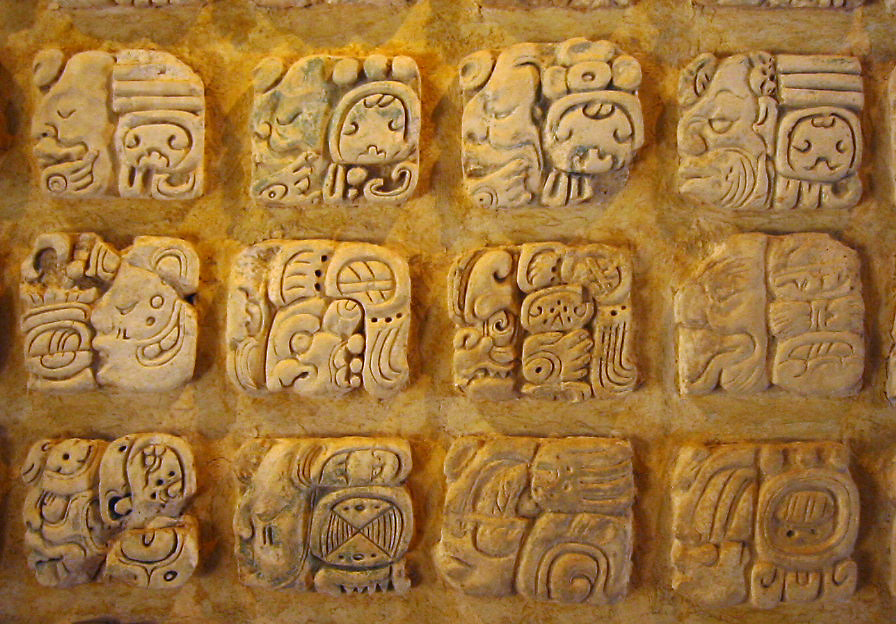
One such being that almost all of the world's scripts trace their origin to pictures (Korean script seems like at least one exception), but most have evolved to the point where it is difficult or impossible to recognize the original depiction. Mayan glyphs hew closely to their pictorial origins, as the sample above demonstrates.

Or look, for example, at a glyph for the syllable "A", taken from a picture of a turtle:


Compare, for example, to the Chinese ideogram for "turtle":


This is quite a bit more stylized, although still vaguely recognizable: legs on the left, carapace on the right, head at top, tail at bottom (and this is as pictorial as modern Chinese characters get).

And by the way, who draws a picture of a "turtle" and stops with the head? It goes to show how culture affects the way we see things in unexpected ways. The Mayans really seem to like pictures of heads; how many can you count in the sample above?

Although Mayan is not a dead language (plenty of folks speaking Mayan as you read this), the glyphs essentially qualify as a dead language—the ability to read them having been lost and only recovered fairly recently by dint of enormous effort. I am therefore applying my "dead language" policy to this project, meaning that I am concerned essentially with reading, not at all with writing or listening, nor speaking, beyond the bare rudiments of pronunciation. It actually make sense to pay some attention to pronunciation with any language, dead or living, as every script I have come across so far relies at least somewhat on phonetic relationships—and Mayan glyphs certainly do; a single word can be written in multiple ways, linked only by its pronunciation. Some of the speaking and listening activities I would normally rely on in language study are therefore irrelevant.

Anki software is quite adept at handling a variety of scripts, but I'm not sure whether fonts for Mayan glyphs exist (Unicode does not appear to include a relevant coding standard), but the very idea of a font is rather foreign to the script. Any given glyph appears in at least a a few variants, with great allowance given to the artistic inclinations of the individual scribe. I'm not sure whether any given glyph ever appears twice in exactly the same form.

I therefore rely on importing images into Anki. I can scan or clip source images (such as the turtle-head above) and paste these into Anki flashcards.

A feature of Anki is the ability to associate several cards with a single "fact", which is a set of associated data fields. In this case each "fact" consists of seven data fields:

(1) The image of the glyph.

(2) The pronunciation. Some glyphs may have more than one such, in which case I list them.

(3) The meaning. Some glyphs represent sounds only, in which case this field is void. Others may require a listing of several possible meanings.

(4) The object depicted. This is distinct from the "meaning", in that a glyph which does not mean anything as such may still be designed to resemble a real-world object  (this is the case of the turtle-head glyph above, which does not have an associated meaning but merely represents the 'a' sound).

(5) A mnemonic phrase. I found this extremely useful in learning the Thai alphabet, For example Mr. Turtle Head up there gets the somewhat arbitrary name "Angry Turtle." The "Angry" is to remind me that the sound is "a". Or, again, the glyph


which is pronounced "i" and depicts I-have-no-idea-what, gets the nickname "Icebox." The glyph


which is pronounced "ba", gets the nickname "BAgel". I don't necessarily plan on coming up with a mnemonic for every glyph, but certainly the purely phonetic ones.

So I could use the following cards for each Anki "fact":
1. Stimulus: picture of the glyph. Response: the glyph's reading, with the mnemonic provided as an after-the-fact hint.
2. Stimulus: picture of the glyph, and the reading. Response: the glyph's meaning.
3. Stimulus: picture of the glyph and the reading. Response: the glyph's mnemonic.
This is in line with the principle that the response for any card should be short and sweet as possible. If a card's response consists of two or more pieces of information, it's better to use multiple cards, with one piece of information each. Not every glyph gets every card. If the glyph has no inherent meaning, I skip Card 2. If I don't assign a mnemonic, I skip Card 3.

If previous experience (with, for example, Egyptian hieroglyphs) serves, the more pictorial the script, the more easily is sticks in the mind. In fact for the first 21 cards, Anki reports my success rate is 100% (whereas typical is more like 85%).